
To view the original post on LinkedIn click here.
In this edition we analyze Gamma, a generative AI company that has been around for some time – at least in AI years – and that was founded in 2020 to replace traditional, linear PowerPoint presentations. Their original product struggled to find market fit and they almost went under a few years ago, because as it turns out, people like slides – they just don’t like making them.
Facing certain failure, Gamma stopped answering why presentations need better design and asked a new question: why do they need to be designed by hand at all?
With their newfound framing of the market problem, Gamma completely rearchitected their platform from scratch with the goal of enabling non-designers to easily create beautiful, well-designed presentations without cognitive friction.
The result is they went from 60,000 users in 2022 to more than 70 million today.
But the "GenAI" market is crowded, and the big productivity suites are injecting AI into their presentation software as well. Is Gamma positioned well enough to keep competition at bay? Let’s dig in.
The market relevancy report is broken into 5 categories: 1) Product Market Fit, 2) Purpose & Impact, 3) Value Proposition, 4) Positioning & Differentiation, and 5) Competitive Moat.
Each category has a total possible value of 20 points, for a collective total possible score of 100.
1) Product-Market Fit
Gamma emerged during the early days of the GenAI wave as one of the pioneering AI-native presentation platforms. Since then, Gamma has raised $87 million in total funding with the latest round, a Series B led by the legendary Andreesen Horowitz, injecting $68 million last November. They also announced crossing the $100 million ARR milestone with over 70 million users.
Though these funding figures are not small, they’re nowhere near the quarter billion dollar rounds we’re seeing lately with other AI players, and Gamma’s journey is going on 5 years.
This wasn’t an overnight success, and the conservative approach to funding was deliberate. In co-founder Grant Lee’s own words, they chose to focus on profitability over vanity metrics, and magical onboarding over marketing. This strategy paid off as Gamma has been profitable for the past two years and is valued at $2.1 billion with only 50 employees.
The revenue, user, and usage figures all point to Gamma having found product-market fit, especially in a market that is saturated with “free” tools from the large productivity suites (Microsoft PowerPoint, Google Slides, etc.), but let’s break down these numbers to add some perspective to the analysis.
Mixed Signals:
Gamma touts that 1 million “creations” are made on their platform every day – impressive. That’s approximately 30 million per month out of 70 million total users – less than half. It’s difficult to read into this too much without understanding how often a user iterates on a single creation and how often new content is created, but a recent company video showed a single presentation being created in less than a minute.
So, without knowing the breakdown of usage, it’s plausible to assume that probably less than a third of users are deriving value from the platform on a monthly basis.
Speaking of value, it’s been reported that out of the 70 million registered users, only 600,000 are paying customers. That’s less than 1 percent of the total. You could look at that as a pathway to major revenue growth . . . but you could also take the view that most users are passive and non-converting, and subject to being pulled away by other free tools.
On the utility front, Gamma receives praise for its ability to quickly develop well-designed and formatted content, but there are reports that after first draft it can be difficult to edit, has trouble with word-heavy content, and can have format issues with exporting into standard slide applications.
There is also the general challenge with AI content generation tools “hallucinating” incorrect information or imagery. And of course, the cloud privacy data concerns. These elements together could cap use cases and jobs to be done.
PMF SCORE: 17/20
Why 17: Gamma is scaling profitably with both registered users and revenue growing impressively over the past couple years, but the growth in users is showing signs of slowing down after an initial period of viral hyper growth (50 million users in mid-2024 to 70 million in late 2025) and the monetization of users is below 1% of accounts which could be signs of retention and conversion challenges. Additionally, there are concerns around utility depth, which would limit broad market adoption and growth potential.
2) Purpose & Impact
“We build tools for imagination”
Gamma’s mission is to democratize creative design – enabling non-designers to quickly and easily produce and share professional-quality content – and in a “more magical way.” Ambitious indeed, like other surging AI startups, Gamma is addressing a big, underserved market – anyone who doesn’t have access to a design team.
This mission also opens them up to other use cases outside their initial target of slideware and you can see it in their products already – websites, social media, and documents.
The “magical” aspect is a way to let their customers – and themselves – know that whatever product or feature they build will be unique experience and held to a high standard.
They speak to these users in terms of believing in them and their ideas.
P&I SCORE: 18/20
Why 18: The best mission-driven purposes embody an element of not only who they serve but also have an emotional connection with that group. This serves as a guide rail to keep the company focused on the customer but should also have built-in flexibility and unlimited potential. Gamma’s mission to literally make their users look good with professionally designed media and their message “we’re building Gamma because we believe in you and your creations” does this well. Their mission also leaves a lot of room for growth and expansion, while still focused on these users – just think of all the different places “design” is needed. For these reasons, Gamma scores high marks here.
3) Value Proposition
From Gamma’s website and other published content, and a little creative license from yours truly, we can construct a value prop along these lines:
Our powerful AI tools help you easily transform and share your thoughts as beautiful presentations, websites, social posts — and anything else you can dream – so you can focus on educating, raising, attracting, closing, or serving clients professionally and with confidence.
Our AI magically places the power of a world-class creative team at your fingertips, literally as you direct through text prompting, generating polished assets in a matter of minutes, not weeks, and without a big invoice – get started for free.
Punchline: Build professional-quality presentations and digital assets without an expensive design team and in a fraction of time through easy prompting.
Compelling and powerful for anyone who is intimated by design or needs to move quickly, but let’s break this down into the value prop components.
Target Customer (Who):
Non creatives with an idea that needs to be presented
Educators/Teachers, Founders, Marketers, Sales, Consultants
We see signs of ICP and positioning – primarily for personas outside the established corporate org chart but also Sales & Marketing (I’m curious what brand and design teams will think of this).
Problem/Need (JTBD):
Develop high-quality content from ideas and imagination
Lack of know-how, time, or budget to craft creative assets from scratch
Job-oriented objectives (educate, close, etc.)
A high-value need + emotional connection.
Product/Service (Solution):
Gamma’s AI-powered and magical content designer
✅Check off the AI box – with inference of a better experience.
Key Benefits (Value):
High-quality content
Speed – minutes vs weeks
Cost – start for free
Confidence
These are strong proof points with a bonus of a psychological benefit – confidence – something anyone will need when embarking on a solo mission. Like other GenAI providers, Gamma doesn’t explicitly compare their pricing to displaced costs – in this case, creative designers – in any of their content, but starting for free certainly sends that message.
Differentiation (Why Gamma):
For non-designers, with use case specialization
Easy, magical process
Beautiful, professional quality
Gamma does a good job speaking to a large cohort, but at the same time differentiates itself in use case, experience, and quality of output/product.
What we don’t get is explicit callouts of how Gamma is better versus competing products or alternative solutions (e.g., LLMs). Generative AI capabilities are accelerating with every model release and we’ll look at positioning and differentiation next, but they’ll eventually need to home in on these specific contrast points.
VALUE PROP SCORE: 17/20
Why 17: Overall, Gamma does a good job of addressing targeted customers with high-value needs and strong benefits of using their product, including psychological and emotional elements. However, as the market grows more crowded and competitive, they will need to contrast their solution against more specific competitors.
4) Positioning & Differentiation
When entering a market with large, well-entrenched incumbents – even with a new technology and approach – positioning and differentiation are critical to capture market share and defend against rapid competitor catch-up.
There are many presentation software products on the market. For this report, I went with a cross-mix of pure-play, AI-first, and incumbent productivity platform players to compare against. This is not a detailed feature comparison exercise, rather a “who do they serve and with what advantage” analysis.
The following are positioning quadrant view across a few categories to visually analyze how Gamma is differentiated from its market competitors. There is no right or wrong quadrant in each chart – it’s simply reflective of strategy (where each competitor plays and how they’re positioned).
Target Market
This category is all about target customer – looking at both type of business (Industry) and business size (# employees & total revenue).
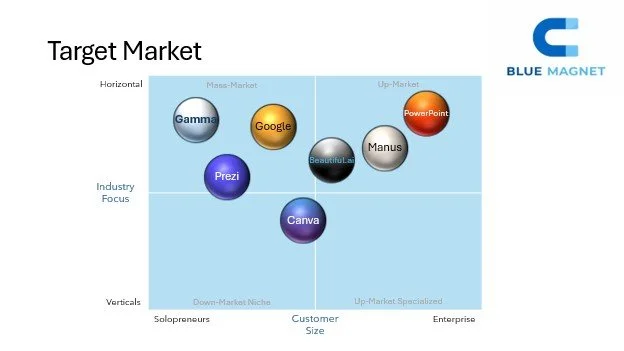
Gamma targeting down market with a broad, horizontal play
Gamma is going after the mass market with very little industry focus and skewing down market with customer size when comparing to the other highlighted players.
This makes some sense as their products fill the gap of design and creative resources that larger companies likely have access to.
Product Focus
Product focus is about who you are building for and which use cases you are covering. Some companies are highly focused on specific roles and use cases and go deep with capabilities that resonate with their users – Canva is an excellent example here. Others take a broader approach to position themselves as the tool for anyone and everything – we see the hyper scalers here.
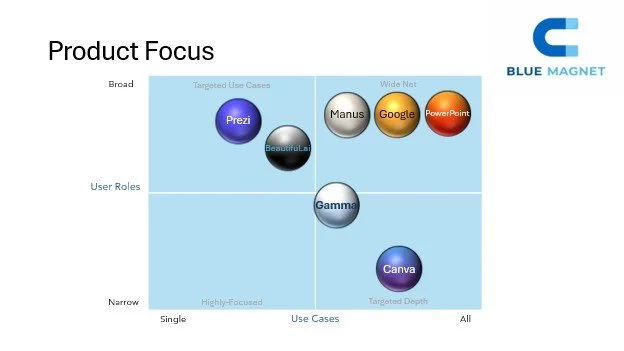
Gamma stands out with focus on specific roles and use cases
Gamma leans towards serving specific users with more depth, so we see them in the targeted depth quadrant, along with Canva. They serve consultants, marketing, sales, and educators. For use cases, they range from pitch decks and proposals to social media posts and websites, to interactive lessons.
For these reasons they show clear separation in positioning as a “targeted depth” player.
Platform Value
This view is to generally gauge the depth of value being delivered by the product through pricing strategy and breadth of capabilities.
For “Utility,” I took into consideration the amount of the design-oriented artifacts covered (i.e. JTBD), extensibility of the platform (integrations, APIs, etc.), and overall feature set.
An important note is that this is best effort positioning where a few of the providers have platforms that go well beyond creative asset design and into other product arenas, so are not 100% comparable to the more category focused players; particularly, Google Slides, PowerPoint, and somewhat Manus, as these products are bundled into much broader platforms (e.g. productivity suite, security tools, app development and agents, etc.). We should not confuse depth of single product with depth of utility, as their position is more reflective of pricing leverage and the ability to serve customer needs on multiple fronts.
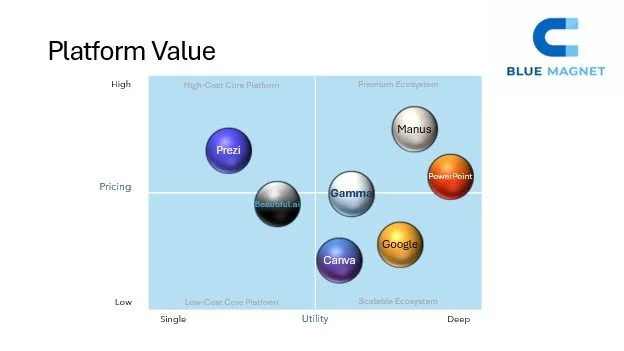
Gamma leaning more into an ecosystem play with balanced pricing
Gamma can build not only presentations, but websites, documents, and social media content and they include these capabilities from the start within their free plan. So, utility is broader than the more presentation-focused players and barrier to entry via price is very low.
Gamma’s pricing is largely usage based with some advanced features and model access coming with more expensive plans, so certain requirements (e.g., premium image models, custom branding/fonts, API access, analytics and sharing, etc.) can move them more into the premium space. Their plans do a nice job of reflecting value, as customers pay more when using the platform in high volumes and/or consuming features they may not get from alternative solutions. Their paid plans start at $9 per seat / per month and are competitive with respect to price-point, but go up to $90 which is why we see them straddle the X-axis.
They also have Gamma API to enable customers to build content within any workflow from any tool/application they may do work from. The API can also be used to develop a custom visualization layer. A couple weeks ago, Gamma announced a connector for Claude in partnership with Anthropic to enable their tool for the “agent-first world.” More on this in our distribution section.
For these reasons, Gamma is positioned more as an ecosystem vs a core presentation product and rides the line between an economically scaling solution and a premium one.
POSITIONING & DIFFERENTIATION SCORE: 17/20
Why 17: Gamma does a pretty good job of positioning themselves uniquely within the market. Their mass market targeting is ok here, because they do enough to differentiate based on their targeted users and what they can accomplish on their platform. They also have smart, value-aligned pricing we’ll look at further in the next section.
5) Competitive Moat
Having a competitive moat – an advantage that provides a company with a distinct edge – is essential for sustaining long-term growth and market relevancy. Moats can come in many different forms, but I’ll focus on the areas of product and technology, distribution, and pricing.
Product & Technology
In this section we look for any technological advantages or related attributes that would raise the barrier of entry – things like proprietary innovations or advanced systems. There are also product and brand elements that can provide a leg up on competition.
Let’s take a closer look at Gamma’s technology stack and product experience:
AI Models – Gamma has built a multi-model AI orchestration architecture – simultaneously deploying 20+ specialized models for text, image generation, layout, and brand consistency – providing the flexibility to select best-in-class models per task as the AI leaderboard shifts, something single-vendor competitors like Microsoft (OpenAI-only) and Google (Gemini-only) structurally cannot match.
The tiered model access strategy (basic models free, premium models credit-gated) is an interesting monetization lever, but risks becoming a friction point as competitors like Copilot normalize flat per-seat pricing in enterprise.
The multi-LLM approach to text generation (confirmed Anthropic + OpenAI + Google on their subprocessor list) is increasingly table stakes as most serious AI productivity tools converge on the same frontier model providers – Gamma's real defensibility here is in how it orchestrates those models for design-specific outputs, not the model relationships themselves.
Data – Gamma’s AI orchestration strategy is informed by continual experimentation and tracking of performance metrics – yielding substantial data on which model works best for which tasks. They also collect engagement data on the content itself, providing actionable insights and a feedback loop on what good content looks like. Their competitors will be collecting similar data and looking to innovate themselves, but the scale and openness of this strategy could provide a competitive edge when it comes to delivering a better product.
Experience – Gamma was designed from the beginning to simplify presentation creation and this shows up in their clean, journey-focused getting started experience. The result is a frictionless, “fast to a first draft” output. This has served them well early and is a hallmark of their brand strategy.
However, friction begins to surface in the post-creation experience. Reviews on Trustpilot (1.7 rating) point to frustration around editing and manipulation of content, design consistency, quality of image generation, and others that waste time and make the creation process complicated. Gamma will need to deliver a higher-quality and more reliable post-draft experience to maintain user satisfaction and growth.
Distribution strategy
Gamma’s distribution strategy is a product-led growth model focused on virality and frictionless, self-serve adoption – like other high-growth, modern startups – but they have gone deeper in a couple areas to create compounding growth loops. They also built their product for the global market from the start. Let’s break down some of these elements:
Product-Led Growth – Gamma’s product strategy is to solve the “blank page” issue of content creation – going from idea to draft. This is being replicated in the market but was the initial PLG lever that ignited growth and attacked the early drop-off from legacy products. The frictionless onboarding, supported by a freemium model, is the next step in the sequence, and the built-in branding of Gamma with easy content sharing and viewing via link (versus file) creates the viral loop of new user awareness and signup – rinse and repeat.
Influencer-Led Marketing – Gamma was intentional with cultivating early influencer relationships and developed an always-on creator ecosystem that includes over 150 creators and numerous agencies across all the social channels. With the rise of AI noise in the market, modern marketers are relying more on trust-based engagements, so Gamma is relying on the creators’ creditability to fuel their top-line funnel.
Rather than paying mega-creators, Gamma’s founder personally onboarded early creators 1:1 to teach them how to use Gamma for their own needs – focusing on thousands of micro-creators whose audiences trusted them deeply, creating a wildfire-style diffusion effect that scaled far faster than paid ads.
They then systematized the program: Gamma ran influencer programs the same way they ran A/B tests – dozens of micro-creators tested in parallel, new accounts seeded to maximize algorithmic upside, creator incentives tied to performance not delivery, and hooks and formats tracked like funnel metrics. This essentially turned the creator network into a distributed R&D lab for narrative and format testing – a meaningful operational advantage over competitors running traditional content marketing.
This approach has been integral to Gamma’s growth, with Offlight reporting last year that 25% of users come directly from social referrals and 40% via word-of-mouth.
Strategic Partnerships – Gamma’s primary distribution partnership is with Anthropic. Announced in late February, Gamma partnered to build a connector into Claude to directly turn research summaries, project plans, and meeting notes into polished visual presentations, and to establish a strong position in the new agent-first world.
This is smart and aligns well with the problem they’re solving – getting past the blank page. People are doing more work directly within the LLMs, from researching and planning, to connecting data sources and agents to streamline and AI power-up their output. Content creation is a natural extension of this work and doing so without having to leave Claude’s user interface is a strong proposition. Gamma wants to be the presentation layer for the agentic world.
No doubt their competitors view a similar future and will be working on their own integrations, so I’d expect to see similar announcements with OpenAI, Gemini, Perplexity and others. Whoever wins the in-app LLM recommendation and referral battle wins the channel – let the games begin.
Pricing Strategy (Balance)
Pricing strategy in the AI generated content space is influenced by the underlying AI model costs, and Gamma utilizes far more models than most, but they take a balanced approach to both model selection and their pricing strategy. They’ve removed the barriers to using their product with a freemium plan (not uncommon) that includes most of the utility of the product (less common). Pricing scales up with access to more credits and adoption of more powerful AI models and features, including some natural triggers/signals of adoption and expanded use (e.g. watermark removal, custom branding, greater per prompt output, etc.). This creates an organic pathway to account revenue expansion.
Here’s a breakdown of the components of Gamma’s pricing strategy:
Freemium Pricing – users can create for free, which is lowers the barrier to entry and is a strong strategy for a new technology like this, but the free plan enforces a credit-based system for all actions, including edits, so there’s potential for friction and adoption here if issues arise with quality and accuracy of the first draft – or subsequent edits.
Paid Plans – as referenced, paid plans introduce measured increases features, capabilities, and price points; providing a balanced, value-oriented approach. Though, they do scale towards the high-end of market pricing with power-use.
Positioning – Affordable, prove and show value before spend. Premium when it’s warranted.
Switching costs – Many providers have the freemium approach, but many gate the AI-powered features, which give Gamma an advantage upfront and no real disadvantage until use and feature need mature to higher levels – though at that point, Gamma retains a competitive edge in theory with it’s model selection. The real threat arises when being compared to the providers that bundle both their presentation capabilities and AI into larger enterprise suite bundles – where the end buyer is leveraging a larger corporate purchase and can view it as a subsidized, or at no, cost.
Gamma delivers here in providing differentiation via their pricing strategy, primarily through making their core AI capabilities available to freemium users from the start. So, users should have less friction and a quicker path to broader adoption than other pure play providers.
COMPETITIVE MOAT SCORE: 16/20
Why 16: The combination of Gamma’s multi-model optimization strategy, frictionless onboarding experience and freemium pricing model that finds a balance with feature gating, and their strong distribution strategy that drives word-of-mouth marketing and create where you do work with Claude collectively form a somewhat looping, reinforcing competitive moat.
Weaknesses in that moat begin to appear when you look at the post-onboarding and after first draft customer journey where quality, experience, and support may fall short of expectations. Additionally, with AI-powered presentation capabilities coming native with the large productivity suite players and bundled into their larger offerings (Zoom announced AI Slides last week), you have to wonder how deep “good enough” goes in the market.
Gamma’s Market Relevancy Score: 85/100 “B”
My Point of View
Gamma has done an admirable, text-book worthy, job of creating a new space, disrupting legacy solutions, and bootstrap growing their business at a remarkable pace. Many lessons can be learned and replicated from their brand-building, positioning, and distribution strategies.
Where they may struggle is in user retention and expansion, particularly with the reported issues with editing, exporting, and general customer support. They may also be challenged to expand beyond their current customer and user targets (primarily down market and solopreneurs, consultants, and educators) when going up against players with stronger team collaboration ecosystems and features, and larger economic factors at play with license bundling.
I have a similar thought when it comes to their product expansion into documents and websites – sectors that bring an even larger set of competitors and market dynamics. Not to mention the behemoth of social media marketing. Though, these capabilities being introduced closer to the “blank page” problem may prove to be a strategic advantage and the presentation solution serving as its own distribution channel.
I do believe there is a strong market for Gamma and they’ve positioned themselves well to win a sizeable share of it, but they need to prove their product output is superior to alternatives and the overall experience introduces less friction.
Is Gamma relevant today?
Yes, they absolutely are. And I believe they’ll be relevant within their targeted areas moving forward, but they need to button-up the customer experience and journey after the first draft.
They’ll also need to prove their solution works by highlighting and showcasing real customer use cases – turning that into another viral, credibility-infused distribution strategy – and own the market narrative on why “good enough” is not actually good enough to funnel more of the market to their solutions and away from the mass market products.
Finally, they will need to continue to drive presence within not just Claude, but the other LLMs – the biggest distribution channels of our time. Otherwise, all the other GTM execution may be largely for not.
Thanks for reading. - Matt
The views and analysis shared here are the opinions of the author and are based on publicly available information as of March 2026; they have been compiled and published in the spirit of an academic exercise and may not reflect subsequent developments. Portions of this research were assisted by AI tools; all analysis, conclusions, and editorial judgments are the author's own. The author has no financial interest in, commercial relationship with, or affiliation to any of the companies referenced herein. The accuracy of the information and conclusions provided cannot be guaranteed and should not be construed as investment advice nor guidance on the future performance of the companies referenced.
